
Many learners struggle to prove their practical capabilities to employers. Although they may have relevant skills, these are often invisible in traditional CVs or transcripts. Recruiters in turn lack clear, structured insight into what candidates can actually do. This results in longer hiring cycles, missed matches, and limited access to opportunity for young talent.
This use case enables competency-based talent matching, powered by interoperable skills data and explicit learner consent. Talent is represented through verified competencies rather than only credentials, increasing transparency and trust on both sides of the hiring process.
Through this use case, learners can:
.
Recruiters and companies receive structured, comparable, and machine-readable skills profiles that support faster and more accurate candidate screening. Job-matching platforms benefit from improved recommendation precision and higher placement satisfaction.
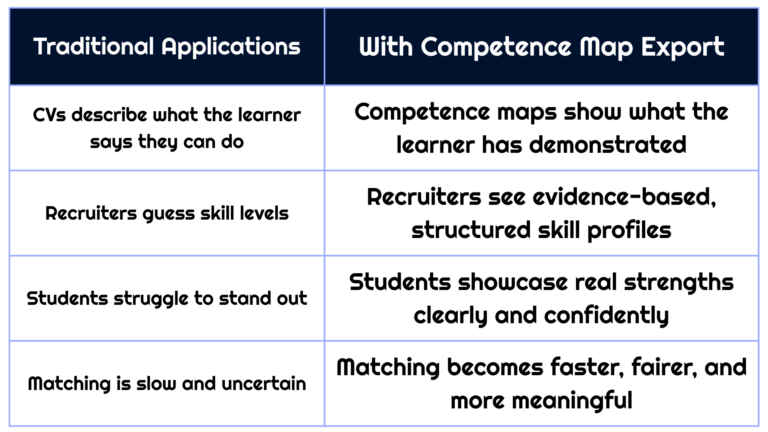
This use case creates value for multiple actors across the education-to-work transition. Learners gain visibility into their real capabilities beyond grades or certificates and can access opportunities aligned with what they can actually do, contributing to a more equitable selection process. Recruiters and companies benefit from reduced screening and matching times, earlier identification of suitable interns and early-career talent, and improved placement and retention outcomes. Job-matching platforms, in turn, can deliver more accurate recommendations and higher employer satisfaction thanks to clearer, structured skills information. Together, these benefits strengthen the shift toward competency-based recruitment.
This use case is collaboratively developed by organizations supporting skills-based recruitment and fair access to opportunities, including Ikigai Games for Citizens, which generates competence maps from gameplay; Schülerkarriere and future matching partners, which connect learners to real internship and job opportunities; and CINAV and FORTEIM, which foster adoption in vocational and maritime training ecosystems.
The Prometheus-X ecosystem provides the foundation for interoperable and consent-based data exchange between platforms. Pilot deployments with learners and recruiters are planned for 2026, followed by broader rollout and cross-sector scaling from 2027 onward. Training institutions, employers, job-matching platforms, and public stakeholders interested in competency-based education and recruitment are invited to participate and collaborate in further developing and operationalizing this use case.
Let’s make skills visible – and opportunity accessible.